Sunday, December 24, 2006

Chomik Catan Cities & Knights License


FEDA Ch

Chilean Federation of Residents Associations in Argentina


FedACH The Board wishes you a Merry Christmas
and reiterates its commitment
for the year 2007 we find more accurate in achieving our
Citizens Rights and welfare of our beloved
Chilean community living abroad.

Buenos Aires, December 2006

Saturday, December 16, 2006

Where To Buy Bulk Chicken In Ohio

Human Rights Day and the project

10 December Human Rights Day
- FedACH Statement on the death of Pinochet -

The figure of General Pinochet will remain in history as the emblem of death, torture, social exclusion, missing persons, stolen. Permanent Human Rights violator. Not only divided Chileans, but also the last part of our history. In the past 33 years there is clearly a Chile before and one after Pinochet. Made the Chilean community living abroad will increase disproportionately.

Since 1973, we generated an explosive growth of Chilean migration amounted to over one million compatriots living around the globe.

A migration that began with the release of political exiles protected by democratic countries, continued the exodus of thousands of Chileans to neighboring countries to protect their lives and their families, went to those fellow political prisoners and tortured they went to arrest and commuting elsewhere sentences of arbitrary judgments, culminating in economic exile, mainly to Argentina, thousands of Chileans who had to leave the country before the government's economic restructuring of the military dictatorship in the 80s, led by Augusto Pinochet Ugarte.

Chilean diaspora abroad is the work of political action, social and economic status of military dictatorship, led by General Pinochet in his 17 years of government, not a product of globalization, as they want us to believe the economists and administrators adherents of the economic model that has reigned since then in Chile.

The Chilean people abroad do not affect rates national job, or social demands, educational, welfare, health and housing, saving the national budget, equivalent to a population as the current IX Region Araucania "(870,000 inhabitants).

However, Pinochet's death does not end with the social and political exclusion of the Chilean population. The governance and social and economic model he originated and is still current, and not recorded in this population of over one million of our fellow residents in the rest of the world.

On the day of his death: "Human Rights Day" is our will that enlighten our leaders and politicians, to repair the rights and participation of our population, excluding the 15,117,000 compatriots who live in our beloved Chile.

Board FedACH


Chilean Federation of Residents Associations in Argentina Buenos Aires


, Sunday December 10, 2006

Thursday, November 2, 2006

Best Hot Mario Salieri

FedACH suffrage of Chileans abroad

Carolina Vergara, interpersonal

early last month, came voices of Government Concertación, to proclaim "urbi et orbi" by Wednesday, October 4 as "a memorable date for the civil rights of the Chilean residents overseas. "

"The proposal submitted by the Government to grant the right to vote to Chileans living abroad, and which bears the signature of Mrs. President of the Republic, was approved in general and particular, by the Commission on Human Rights Human Nationality and Citizenship of the House of Representatives, chaired by Deputy Tucapel Jiménez. "

" So, after 14 years of debates and proposals, which began with the first presentation of the Christian Democratic Rep. Charles Dupre, in 1994 the return to democracy, and continued in 2005, with the motion of Representative Isabel Allende, the Government of the President Bachelet achieves one of the most pressing demands of thousands of Chileans living abroad. "(Foreign Information DICOEX, October 2006).

As sometimes half-truths are half-lies, the FedACH Board reiterated that maintains communications with members of different political persuasions, who commented several edges are unknown to the public. For example, in the mentioned meeting, voted to project only the members of the Coalition. The UDI's voted against and National Renewal, presented a separate draft constitutional reform on "the vote of Chileans abroad and the designation of ambassadors ", a fact that the deputies themselves were unaware of the Coalition and reached the agreement qualify as RN - Veloso (Paulina, Minister Secretary General of the Presidency).

as "something rotten in Denmark", the Board of FedACH sent the note is reproduced below, the Committee on Constitution, Legislation and Justice of the Chamber of Deputies (which studies the project), other commissions and legislators, and in turn, prominent constitutionalists, in order to comment on the consultations there treated.

H. Rep. Pedro Araya

President of the Committee on Constitution Law and Justice H.
Chamber of Deputies

In our further consideration:

FedACH The Board is pleased to address you and honored to lead the Commission, to send you our concerns on the draft amending Law No. 18,700 (Bulletin No. ° 3936-06) and treats the rules for voting of Chileans living abroad.

In this regard, see the following: 1 .-

motion that the Committee began to discuss, on Tuesday 31 of power, is the same one that sent the Commission on Human Rights, Nationality and Citizenship, on Wednesday, October 4 past?

2 .- This motion is it the same original text submitted by the H. Rep., Isabel Allende and other Socialist deputies (Bulletin No. 3936-06) in July 2005? Or, is the substitutive, sent by President Michelle Bachelet, the current August 31, the H. Chamber of Deputies (Message No. 249-354)?

3 .- This clarification is vital because the draft Rep. Allende (Bulletin No. 3936-06) proposes:

"Article 182 .- The Chileans residing permanently abroad and meet the requirements mandated by law to be citizens may exercise their right to vote in elections for President of the Republic, Senators and Representatives, Mayor and Councillors, can vote, further referendums stipulated in the Constitution. "

substitutive While the Government (Message No. 249-354) states:

" Article 179 .- He shall perform overseas votes to be elected as President of the Republic and in the case of referendums regulated in Chapter XV of the Constitution of the Republic. "

4 .- The motion of Deputy Allende can be considered extends the exercise of sovereignty of Chileans living abroad, beyond legitimate participation in the renewal of the branches of government: executive and legislative branches, and vote in municipal elections, which also has its own electoral system.

5 .- On the other hand, the substitutive government limits the exercise of sovereignty to Chileans living abroad, to participate in the renewal of a single branch of government: the executive, ie exclusively cover the presidential election.

6 .- It is noteworthy that the substitutive made by the Government (No. 249-354) does not correct the errors that had the other substitutive (No. 177-342) led by President Ricardo Lagos, who presented in August 2000, H. Senate a project of the same nature (Bulletin No. 268-07) and that was rejected repeatedly in different courts as unconstitutional because it "is considered discriminatory to limit the expression of suffrage for foreign residents only for presidential elections creating a clear constitutional problem because it would establish a clear legal inequality between Chileans who vote abroad and those who voted in the country. "(Bulletin No. 268-07, Note No. 148).

7 .- In October 2000, CasaChile.cl said following a session of the Commission on Government, Decentralization and Regionalization of H. Senate
"The bill seeks to grant the right to vote to Chileans living abroad could be considered unconstitutional, they said the lawyer Francisco Zuniga, in the fourth session of the Senate Committee on Government to analyze the bill.
Zúñiga argued that restricting the right to vote guaranteed by Article 5 of the Constitution, while the Chileans living abroad could only vote for the election of President and referenda, not elections. In his view, this would be essential to solve for the effects of adequate treatment of the project.
The Constitution states that sovereignty resides in the nation and its exercise is done through elections and plebiscites. Therefore, give the right to vote only a portion of these instances, would restrict this right, why would estimate that the project would be unconstitutional. "

8 .- There is a lot of material and opinions of knowledgeable Chilean constitutionalist who hold this view, the exercise of sovereignty by the people, involves the participation of citizens in periodic elections in the renewal of the powers of authorities Status: Executive and Legislative. That these choices are directly related is shown by the Constitution, which states:

"Article 26 .- The President shall be elected by direct ballot by an absolute majority of the votes validly cast. The election shall be held in conjunction with the parliamentarians, in the manner determined by the respective constitutional organic law, ninety days before the date on which the office should he cease to be in office. "

And the preamble to Law No. 18,700, the Constitutional Organic Law on Voting and Elections:

"Article 1 .- This law regulates the procedures for the preparation, implementation, counting and classification of referendums and elections of President and Parliamentarians. "

9 .- On the other hand, Parliament is not giving the right to vote to Chileans living abroad, as it is explicit constitutional guarantees. What Parliament legislates, is the way this sector of society will exercise this right, as indicated by repeated our Constitution:

"Bases of Constitutionality"
"Article 1 .- The persons are born free and equal in dignity and rights. (...) It is the duty of State
(...) safeguard and secure the right of individuals to participate with equal opportunities in national life. "

"Article 5 .- The sovereignty resides essentially in the Nation. It is exercised by the people through periodic elections and referendum (...)
The exercise of sovereignty is limited by respect for the essential rights emanating from human nature. It is the duty of the organs of State to respect and promote those rights guaranteed by this Constitution and by international treaties ratified by Chile that are in force. "

" Article 15 .- In the popular vote, the vote shall be personal , equal and secret. For citizens is also required. Only
can be called a popular vote for elections and referendums expressly provided in this Constitution. "

" The rights and constitutional duties "
" Article 19 .- The Constitution guarantees all persons:
2 .- The equality before the law. In Chile there is not, privileged persons or groups. In Chile there are no slaves and that steps on its territory is free. Men and women are equal before the law.
Neither the law nor authority may establish arbitrary differences. "

10 .- As Chileans residing abroad are the ones who are directly involved in the standardization of our rights as citizens, we would pleased that the Commission honorably preside, wish to invite our Federation, to participate in the study that begins the bill related to the implementation of the vote of Chileans abroad.

FedACH the Chilean Federation of Residents in Argentina, founded in 1995 with legal and No. 16,278 of February 28, 1997. Coordinates about 80 Chilean organizations from Jujuy - Salta to Ushuaia and its objectives: "to adhere specifically to the observance of human rights, democratic values \u200b\u200band principles that make peaceful coexistence of peoples."

Thus, since its FedACH foundation has been regularly visiting the H. Congress and the executive branch in the processing of the draft on this matter transacting the U.S. Senate, Bulletin 268-07. Likewise, and vote on the issue of Chileans abroad, has organized and participated in the following events:

- I Convention Chilenos en el Exterior (Chicago, USA, August 1997, with the participation of Senator Miguel Otero) .
- First Conference on Civil and Political Rights (FedACH: Punta Lara, Argentina, December 1997, participation of the Assistant Secretary of the Presidency, Sergio Galilea).
- Seminar on Strengthening the Chilean community in Argentina (Consulate General of Chile and FedACH, Buenos Aires, 1998, participation of Senator Jose Antonio Viera-Gallo, deputy Edmundo Villouta, Ex-Ambassador Pedro Daza and political scientist Ricardo Israel).
- Open discussion about voting abroad: Institute of Political Science at the University of Chile and FedACH (Santiago, March 1999, participation of Juan Ignacio Garcia, Ricardo Israel, Pedro Daza, etc.).
- Chile Forum on voting abroad: School of Law, University of Chile (Santiago, August 1999, the participation of José Luis Cea, Alberto van Klaveren, Juan Ignacio Garcia, Committee for the right to vote in France and FedACH) .
- International Workshop on Voting Chilenos en el Exterior: DICOEX (Santiago, November 2002).

FedACH and Chilean Associations throughout Argentina actively participated in the registry (or Census) of Chileans Abroad, along with all 13 consulates in this country, the National Statistics Institute (INE) and DICOEX to take a census the 429,708 residents throughout Argentina, in 2003.

think this experience and information gathered, put it deserves the attention of the Committee on Constitution, Legislation and Justice H. Chamber of Deputies, and thereby contribute to the legislative study builds upon the vote of Chileans living abroad.

Waiting for your response to the concerns outlined here, we greeted with patriotic appreciation of the Board.


José Aguilera Muñoz
Secretary


President Carlos Méndez Contreras

FedACH - Chilean Federation of Residents in Argentina

Friday, July 7, 2006

How To Play Pokemon In Macbook

A Mexican corrido

The feasibility of a successful vote on the draft of Chileans abroad is unlikely, as there are sectors of the coalition do not share to be involved in all types of elections.

In the recent message of President Bachelet Br Senate on constitutional reform to allow amendment to the binomial system, the president ratified four of its programmatic commitments on elections. First

: "modify the binomial system for a system to ensure competitiveness, representation and governance."
Second "automatic voter registration, for more than two million Chileans are of voting age are not exercising their right to vote."
Third "vote to Chileans abroad, if we want a more just, inclusive and diverse."
Fourth "allow greater participation of women in politics."

The message adds: "Through this proposed constitutional amendment, the Government fulfills the first and last of these three (sic) commitments."

"Regarding the other two commitments, is ready to be voted on Chamber of the House, the bill provides for automatic enrollment. And the past week, scored with simple emergency motion of a group of MPs who can vote for Chileans abroad. "(Post 142-354, pages 1 and 2) Outside

whore commitment (in what is written "three commitments" when they are four) that we will discuss concerning voting of Chileans abroad, motivated by the second major addition this year, nationals living abroad. The case of Mexican voters who voted in their countries of residence for the elections on Sunday 2 July. Previous weeks and months, as voters were also incorporated from the outside, the Italians, in the parliamentary elections and referendum in their country of origin.

In Chile - are promises, promises are - there is no indication that the current presidential term the project will be implemented and the law that allows Mexican citizens to vote from their home countries.

Currently there are two Bills in Congress on the subject: one in the Senate (Bulletin No. 268-07) deputy project Dupré (1991) with a substitutive Lagos government (August 2000) in different courts repeatedly rejected as unconstitutional and "It is considered discriminatory to limit the expression of suffrage for foreign residents only for presidential elections, creating an obvious constitutional problem because it would establish a clear legal inequality between Chileans abroad vote and that they bear in the country. "(Bulletin No. 268-07, Note No. 148)

The project in question was found trapped between the Committee on Foreign Affairs and the Constitution, Legislation and Justice of the Senate during the government of Lagos (2000-2006) without the Executive took the political initiative that corresponded with one of its flagship program commitments.

The other project, of more recent data, presented on the campaign trail in July 2005, several Socialist members, includes criticism of unconstitutionality of the previous draft and proposed that "Chileans residing permanently abroad (... ) may exercise the right to vote in elections for President, Senators, Congressmen, Mayor and Councillors, can vote, also in plebiscites provided by the Constitution. "

"To that end believe it a Voter Registration Residents Abroad. (...) At each embassy and consulates consuls served by Chilean (...) Special Voter Registration is open until the hundredth day before an election. (...) (...) The voter registration work in the headquarters of the Mission or Consulate (...) At registration, the Chilean foreign resident in the commune will for your last domicile in Chile. "(Articles 182 and following of the Bulletin No. 3936-06)

"The vote of the citizens will be issued on the same date which is issued in the territory of the Republic. (...) To receive the vote of each record is designated an Integrated Receiver Bureau at least three and not more than five electors alphabets and seers who shall serve as members. (...) The election of officers shall be governed by the rules laid down in Articles 71, 72, 72 and 74 of Law No. 18,700. "(Articles 187 et seq Bulletin No. 3936-06)
There
major political sectors (Concertación and National Renewal) that support this idea of \u200b\u200blegislating, as they consider "fully recognize valid right to vote to Chileans living abroad, ascribing to his native community, the system used by other States with relevant experience. " (Letter to FedACH Sebastian Pinera in Presidential Proposal)

However, the feasibility of this project to flourish in the legislative process of the Chamber of Deputies is quite remote, as there are also policy areas that do not share that Chileans from foreign participation in all elections.

"I think there are elections that have absolutely nothing to do. In a city election, any person not residing in Chile, a municipality may be entitled to vote. The development of a community is very directly related to the base, and is therefore very crucial place of residence of the citizen. Then, at the municipal level I do not consider it relevant to a vote. "(Senator Carlos Cantero - RN, who voted in favor of the previous project, the Commission on Government, Decentralization and regionalization of the H. Senate)

share also in the Coalition this criterion as socialist politicians like Democrats. Interior Minister Andres Zaldivar, voiced this in the interview he had with leaders of FedACH last April in La Moneda. As Ambassador Luis Maira at a hearing granted in August 2005, at the Embassy in Buenos Aires. They define the suffrage of Chileans abroad is contingent solely to the elections for President of the Republic "and will not be responsible for the consequences of the outcome of a parliamentary vote." That same argument Senator Larraín - UDI to oppose the foreign nationals to vote in presidential elections.

This lack of unity and coherence of the coalition and the government causes the project is unsuccessful Socialist deputies in the proceedings of committees since July 2005, even though he has been described as simple urgently 06/06/1906 (Address 135-354). The project will be voted for the House of Representatives should continue a second step in the Senate where he will meet with the other project of the past efforts and the comments of his detractors.

We then have two projects, one in each chamber. Project (Bulletin No. 268-07) in Senate with constitutional problems as discriminatory because it limits the exercise of suffrage for Chileans living abroad only for presidential elections. And the project (Bulletin No. 3936-06) in the Lower House, which would solve the discrimination and unconstitutional, to promote the vote of Chileans abroad in presidential elections, parliamentary and local, but that does not have consensus and agreement of the Concertación legislators themselves and less required vote of 4 / 7 in each chamber for being a Constitutional Law.

Who will sponsor the project before the Congress vote of Chileans abroad or take political responsibility for his conduct? "Paulina, Alexander or Andrew? A bit of history.

The Lagos government was awarded the issue to the Ministry of Foreign Affairs, the Foreign Minister Alvear and operation of the DICOEX, so that the Interior Minister Insulza, not included in discussions and negotiations held with the opposition to constitutional reforms. The ministers of the General Secretariat of the Presidency at the time, did not have it in their legislative schedules, and the 2 nd floor either. So what we reported in January 2004 when she had taken the political decision not to legislate, that is, that Chileans living abroad did not participate in the elections of December 2005, from their places of residence but from 2010.

The DICOEX organized a seminar on the important topic with participants from various sectors of the establishment, in November 2001 and funded a study and publication of a book to be presented during 2004 on the alleged appointment of Eduardo Frei Ruiz-Tagle as presidential candidate. Political events followed other paths, so that several hundred copies of the book are trapped in DICOEX offices, in the same way that the draft law with substitutive of President Lagos, by this video from La Moneda conference with the embassies of three cities: Buenos Aires, Madrid and Stockholm in August 2000, lies in a Senate committee.

At the hearing we had with the Minister Zaldívar in April, formally asked to assume the leadership of this project. Moreover, we need you to include it in the reform of the whole electoral law. The answer was recently given the Government with the message quoted at the beginning of this article. Every project must be separately it must also counter with the time factor.

DICOEX The overwhelming complacency. Against our proposal to participate in presidential and parliamentary elections, choosing our own representatives to Parliament, creating a own constituency (the Italian model, do you remember of the Region XIV?) Or voting for parliamentary candidates in our districts voter registration, according to the project of the Socialists (English model) - answer - "The Italian model is not applicable, because Italy is a parliamentary republic and a presidential republic Chile. On the other hand, Italians abroad took nearly 30 years to achieve his goal and we just carry fifteen. "

6 years ago, who signs this note, he wrote an article analyzing the same situation entitled" The year after pill " (CasaChile.cl - 2001) which noted the risk that the proposed vote of Chileans abroad not be processed and that the promise / commitment of President Lagos did not materialize. Unfortunately we were right and more than 850,000 Chileans living in different countries in all continents, were severed their civil rights.

times for reasons of legislative and policy is no indication that this issue will be given priority in the current administration, for which there will always be other legislative priorities: the creation of the Ministry of Public Security, reform of the Organic Law of Education , the binomial electoral system reform, reform the pension system, the creation of the Ministry of Environment, Capital Markets II, the extension of the Guarantee Fund for Small and Medium Enterprises (Fogape), reform the Code of Military Justice, the law on indigenous peoples, creation of new regions, the choice direct the Regional Mayors and members of CORE, tax reform, law outsourcing, new free trade agreement (FTA), the European satellite purchase, and so on. If the political will to achieve the processing of the bill to permit voting of Chileans living abroad in the elections of December 2009, the law should be enacted in September 2008 to be applied to the outside in 2009. The creation of the Electoral Register of Residents Abroad voters must register at the consulate until the hundredth day before the election of December 2009. However, in October 2008 municipal elections are set for that year, as legislative activity in election campaigns.

Until September 2008 the project will complete its study in various legislative committees (Human Rights, Government Affairs, Constitution, Law and Justice, Foreign Affairs and Finance) for a vote in the House of Representatives, first legislative step 4 / 7 votes. The second step will follow in the Senate to become law. If there is no overlap in the proceedings of each House, it shall be a bicameral commission to study and rescue proposals of each House and reformulate it in a single project and be voted with a quorum of 4 / 7.

Still, the law can be passed, but states continue to suffer from legal inequality between Chileans who vote abroad and those who bear in the country, can be observed by the Constitutional Court, in charge of safeguarding the principle of constitutional supremacy , foundation of the rule of law. We again

very complicated political times and disappointing and it seems that the possibility of a Chilean citizen and join the construction of a society with a participatory democracy from the outside, either as a Via Crucis for believers or Buy Game Balls for the wicked. Do not delve into the 2009 presidential likely scenario where each party, both government and opposition, will try to bring their own candidate in the first round: Alvear, Bitar, Girardi, Gomez, Longueira, Piñera, Zaldívar and the return of Lagos for the bicentennial.

But do not despair as they left teaching high school student demonstrations in May, is that to be a citizen, participating in political activities, not required to be registered in the electoral rolls, to exercise voting rights or belong to a political party. Three conditions that did not meet side by not having 18 and not voted in past elections in December and January. However, given a lesson high politics and civic education: that the social and political inclusion can be achieved with other practices, also citizens.

President Carlos Méndez Contreras FedACH


La Plata, Sunday, July 2, 2006: Election Day, Mexican and participation for the first time Mexican voters living abroad. With memories of the friend, Dr. Leticia Calderón Chelius, Research Institute José María Luis Mora and the Institute for Social Research at the National Autonomous University of Mexico.

Sunday, April 2, 2006

Headscissor Blog Spot

Michelle Bachelet FedACH DELEGATION MEETS

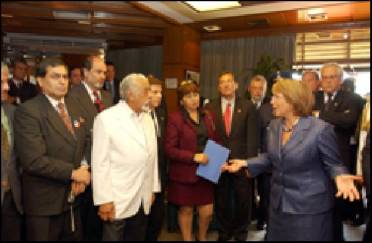
At the domestic airport terminal President was greeted by a delegation of Chileans living in Argentina and gave him a text with requests and proposals. Photo: President
The Nation, Wednesday, March 22, 2006 .-

The Chilean delegation that met with the President Dr. Michelle Bachelet, was nominated by officials Embassy and Consulates, with express instructions issued by the Government until Friday March 18 from Chile.

FedACH present were: Anita Aja (Jujuy), Norma Barra (Neuquén), Homero Rojas (B. O'Higgins), Luis Jara (G. Mistral), Heraldo Hidalgo (A. Prat), Violeta Núñez (P. Neruda), Sylvia Villarroel (Red Solidaria) and Carlos Mendez. Joining them

: Alma Comas (Adachi), Nelson Olfman (Eagles Nest), Hector Orellana (V. Parra), María Concepción Farías (Chivilcoy), Genaro Galleguillos (Salta), Elvira Roco (San Juan), Franklin Caicedo and Michelle Utard. Dr. Bachelet

arrived at the military airport Aeroparque, on the afternoon of Tuesday 21 March, in his first state visit after taking office as President of the Republic of Chile. In this place the authorities hoped the Argentine government, headed by the Minister of Foreign Affairs, Jorge Taiana. Once

rendered military honors, the President went to the VIP lounge where residents hoped the Chilean delegation. After greeting each of those present and present to the ministers and the accompanying delegation, he improvised a speech in which he apologized for the brevity of the encounter with the Chilean community since coming to the country for a short time and should continue its turn immediately to Uruguay.

however, pledged to support a more comprehensive interview with the community in future visits you make to Argentina. Smiling, said knowing the whole situation that happened here in the community, which had previously been in Buenos Aires as a candidate and thanked those who worked for her election campaign.

reiterated the promises of the past presidents of the Concertación (Frei and Lagos) on the vote of Chileans living abroad. Without specifying the form or the manner in which this vote will be deployed overseas, said the obstacles the project has been in Parliament and will help that require MPs to be processed. He indicated that accompanied the tour Senator Carlos Ominami and Deputy Tohá Carolina.

asked those present to participate actively in the management of projects involving the community living abroad, who are identified as Region XIV. Moreover, he referred to the creation of the regions of Arica, which was identified as XV and XVI of Valdivia as words that did not go unnoticed because they establish that the Region XIV of Chilean residents abroad could have an institutional force, losing its meaning merely virtual.

Standard Bar (pictured, above), a national leader and coordinator FedACH associations Neuquén and Rio Black, gave a welcome to President Bachelet for his state visit to our country of residence. The leader expressed to the President, on behalf of FedACH, best wishes for success in his government and gave him a folder whose materials found on the website: www.votochilenoexterior.blogspot.com

Subsequently, President Bachelet agreed to be photographed with the present and before retiring was invited by the authorities in Argentina Air Force to stamp your greeting in the guestbook illustrious. The President wrote a thoughtful dedication, perhaps related with his family experience in the Chilean Air Force, who celebrated his birthday that day and whose ceremony was attended that morning.

After this brief encounter with the Chilean community resident, the President went to the Plaza San Martin where she was honored by the Head of Government of the Autonomous City of Buenos Aires, Jorge Telerman and where he placed a wreath at the monument to General José de San Martín.

then transcribe the greeting FedACH to hand over to President Michelle Bachelet.

Buenos Aires, March 21, 2006 .-

His Excellency Dr. Michelle Bachelet President of Chile


occasion of his state visit to this generous country that shelters us, receive the greetings and welcome to the Chilean collective Resident represented by FedACH - Chilean Federation of Associations of Argentina. With

wish him every success in this visit, as your government has just begun, we must express our regret not having contributed to our vote in his election as Chile's first woman president, since even our right to vote is prevented from our countries of residence.

However, you were elected in the first round that Chileans living abroad organized Dec. 11, earning 54.3% of the vote, 23.6% Tomás Hirsch, Sebastian Pinera and Joaquin Lavin 14% 8.1% through the electronic voting and vote-urn - symbolic choice - in attended by 26,912 fellow from Argentina, Australia, Belgium, Brazil, Canada, Korea, Cuba, Ecuador, United States, France, Germany, Holland, Mexico, Norway, United Kingdom, Sweden, Switzerland and Venezuela.

This shows the expectations it has raised its government in the Chilean community based abroad, but also the desire to actively participate in the proposals is committed to develop.

We are aware that their government will tend to find ways of citizen participation that we would meet and discuss before, about not repeating the experience of partnering workshops developed by the Directorate for Chilean Community Abroad - DICOEX, who did not respect dignity and identity of our fellow citizens from different regions and the jurisprudence of civil partnerships in this brotherly country. Experiences that led to the dispersion and division among compatriots that the search for unity of interest in the ideological and social diversity.

on these proposals, and also we have agreed on our last Congress held in the city of Neuquén, and form a coherent program on civil rights, political, social and cultural rights of the Chilean community living abroad, we would have the opportunity to dialogue and work with their teams of government, issue reach viable plans and projects, discussed and applied in the outside community.

We would also like to actively participate in the development of electoral law reform (as we did earlier) that includes automatic enrollment in the electoral registers, changing the binomial by a proportional system, the creation of a constituency Chileans abroad for choosing representatives to Congress in proportion to the population of 857,000 Chileans living outside the country, so will the Italian immigrants in the coming weeks.

To this end, we respectfully request the formation of a Working Group, which delegates to attend all countries with large Chilean population and representatives of political parties in Chile, to develop a State Policy on Migration Chile, which are included and agreed the draft law on the subject to vote in Parliament.

advocate for you to instruct the formation of this working group and set the guidelines, date and sessions, so we can set our assistance and provide our input in advance.

Waiting for your response to our request, accompany this note, our proposals and documents FedACH Congress III, held in Neuquen, in September.

take this opportunity to greet with great affection and consideration of the Board of FedACH.


President Carlos Méndez Contreras